How court document anonymisation works: a guide for legal professionals
Court document anonymisation is the process of irreversibly removing or masking personal identifiers from legal records so that no individual can be identified, directly or indirectly. Understanding how court document anonymisation works is not optional for legal professionals, data protection officers, or researchers. Regulations including GDPR, CPR 39.2(4), and ICO guidance create binding obligations around court record confidentiality. The distinction between anonymisation and pseudonymisation carries real legal weight. Anonymised data falls outside strict data protection law; pseudonymised data does not. Getting that distinction wrong exposes organisations to enforcement action.
Which personal identifiers require anonymisation in court documents?
Court rules like CPR 39.2(4) and FRCP 5.2 mandate the removal of specific identifiers from legal records before publication or disclosure. These rules exist to balance open justice with individual privacy rights. Knowing exactly which data elements trigger that obligation is the starting point for any compliant workflow.
The following identifiers consistently require anonymisation under prevailing legal standards:
- Full names of parties, witnesses, and minors involved in proceedings
- Dates of birth, which become identifying when combined with other fields
- Home and work addresses, including postcodes that narrow location to a handful of households
- National identifiers such as National Insurance numbers, passport numbers, and Social Security numbers
- Financial account details including bank account numbers, sort codes, and credit references
- Medical and biometric data that falls under GDPR’s special category provisions
- Sexual abuse details and victim identities, which carry heightened statutory protection
Indirect identifiers present a subtler risk. A job title, a rare medical condition, and a county of residence may each appear harmless in isolation. Combined, they can re-identify an individual when cross-referenced against public datasets such as electoral rolls or company registers. Rigorous re-identification risk assessments are therefore required, not just a surface scan for obvious names and numbers. That assessment must consider what external data an adversary could plausibly access.
Pro Tip: When reviewing court documents for anonymisation, treat any field that narrows a population to fewer than five individuals as a direct identifier, regardless of whether it appears on a standard checklist.
What techniques and technologies are used to anonymise court documents?
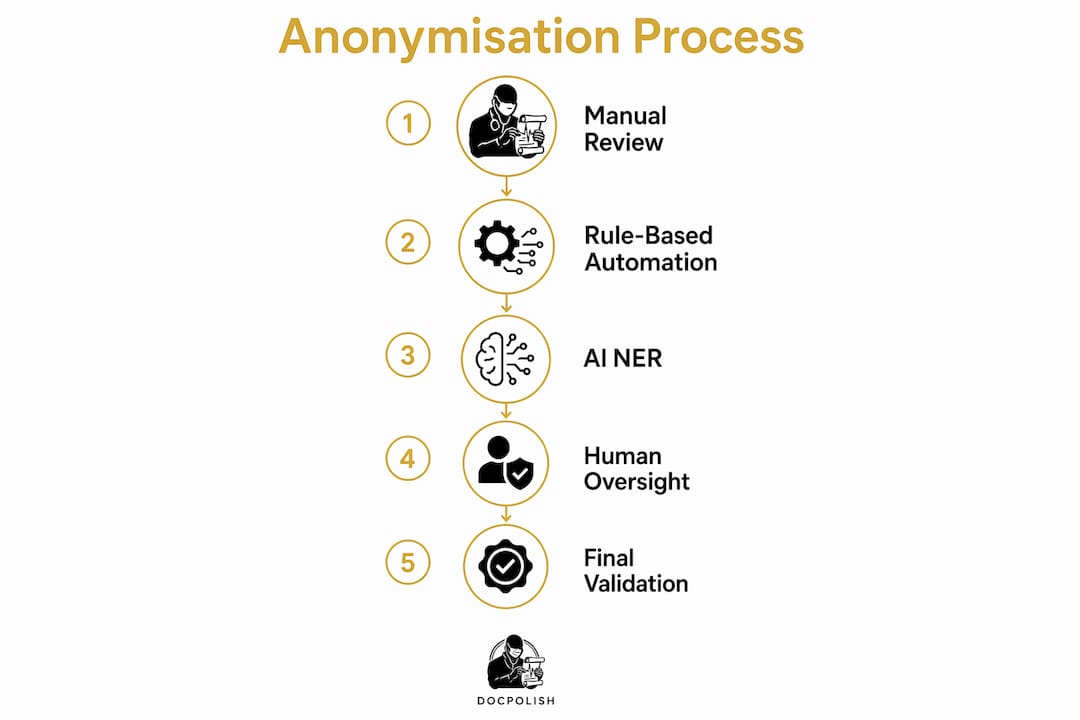
Anonymising court records sits at the intersection of linguistics, law, and data engineering. Three broad approaches exist: manual review, rule-based automation, and AI-driven Named Entity Recognition (NER). Each has a distinct risk profile.
Manual review
Manual anonymisation relies on trained legal staff reading documents line by line and redacting identifiers. The method is accurate for short, straightforward documents. Accuracy degrades sharply as document length increases. A single missed identifier constitutes a privacy failure, regardless of how many were correctly removed. Manual processes also create bottlenecks when case volumes are high.

Rule-based automation
Rule-based systems apply pattern matching to find identifiers: regular expressions for National Insurance numbers, date formats, and postcodes. These tools are fast and consistent within their defined rules. They fail on identifiers that do not follow predictable patterns, such as uncommon names or contextual references to a person’s role.
AI-driven NER and pseudonym generation
NER models trained on legal corpora identify named entities including persons, organisations, locations, and dates. The model flags each entity for removal or replacement. Pseudonym generation then substitutes a consistent fictional label, so “John Smith” becomes “Person A” throughout the entire case file. Stable, non-correlative pseudonyms stored in secure mapping vaults are the industry standard. Simple hashing is insufficient because it is vulnerable to dictionary attacks in small identifier domains.
The accuracy threshold for legal anonymisation is higher than for general NLP tasks. 95–97% accuracy is insufficient when a single missed name can expose a victim’s identity. Domain-specific fine-tuning on legal judgments, combined with gold standard evaluation datasets, pushes recall for direct identifiers toward the level required for production use. Highly specific models fine-tuned for narrow legal domains can achieve 99% recall for direct identifiers, but only when rigorously evaluated. That figure does not arrive out of the box; it requires deliberate training and validation investment.
Combining AI anonymisation with human review produces the best results, particularly in complex or sensitive cases. AI handles volume and consistency; human reviewers catch contextual identifiers the model has not encountered before.
Pro Tip: Build your AI validation pipeline around a gold standard dataset drawn from your specific court jurisdiction and document type. A model trained on criminal judgments may underperform on family court orders, where identifier patterns differ significantly.
How do legal and data protection regulations govern court document anonymisation?
The regulatory framework governing court record confidentiality operates at several levels simultaneously. Understanding which rules apply, and how they interact, is the foundation of any compliant anonymisation programme.
-
CPR 39.2(4) gives English and Welsh courts the power to order anonymisation of parties and witnesses where publicity would defeat the purpose of the hearing or cause serious harm. The rule does not create a blanket right to anonymity; each application requires justification.
-
FRCP 5.2 (United States Federal Rules of Civil Procedure) requires parties to redact Social Security numbers to the last four digits, financial account numbers to the last four digits, dates of birth to the year only, and names of minors to initials. These are minimum standards, not ceilings.
-
GDPR Articles 4 and 89 draw the critical line between anonymisation and pseudonymisation. Pseudonymised data remains personal data and attracts the full weight of GDPR obligations. Only data that is genuinely anonymous, where re-identification is not reasonably possible, falls outside the regulation’s scope.
-
ICO guidance and UK Government data obfuscation policy require data controllers to document their chosen protection tier, whether encryption, pseudonymisation, or irreversible masking, and to record that choice formally before any disclosure.
-
Data Protection Impact Assessments (DPIAs) are mandatory where processing is likely to result in high risk to individuals. Data controllers must document anonymisation decisions in DPIAs to satisfy UK government policy and regulatory expectations. The DPIA must record residual risks and confirm that the data owner has accepted them.
Protective orders restrict access to sensitive forensic evidence in court but do not block its admission. Orders require justification showing that harm outweighs openness; sensitive evidence may be sealed, summarised, or read aloud under strict conditions. Legal professionals sometimes treat protective orders as a substitute for anonymisation. They are not. A protective order controls who sees a document in proceedings; anonymisation controls what any reader can learn from it after disclosure.
Data owners are legally accountable for anonymised datasets, including the selection of protection tiers and the acceptance of residual risk. That accountability cannot be delegated to a vendor or a software tool.
What are the operational challenges and best practices for implementing court document anonymisation?
Operational implementation is where well-designed anonymisation programmes succeed or fail. The technical and regulatory frameworks above are necessary but not sufficient. Execution requires process discipline, secure infrastructure, and ongoing quality assurance.
The most common operational pitfalls include:
- Inconsistent pseudonym assignment across documents in the same case, which allows readers to correlate identities by comparing files
- Metadata exposure in PDF and Word documents, where author names, tracked changes, and revision histories survive redaction of the visible text
- Scope creep in disclosure, where documents anonymised for one purpose are reused in a broader context without reassessment
- Inadequate access controls on pseudonym mapping vaults, which are the keys to reversing pseudonymisation and must be treated as highly sensitive assets
Scalability is a genuine constraint for courts and legal teams processing high volumes of documents. Manual workflows cannot scale without proportional staffing increases. Scalable court document anonymisation integrates automated AI NER models fine-tuned to legal domains with human quality assurance and logging for auditability. That combination addresses both volume and accuracy requirements.
Secure pseudonym mapping vaults deserve particular attention. High-quality anonymisation demands stable pseudonymisation techniques that resist dictionary attacks, involve secure vault storage of mapping keys, and maintain consistency across case files. The mapping table must be stored separately from the anonymised documents, with access restricted to authorised personnel and logged for audit purposes.
Documentation is not bureaucratic overhead. Recording which anonymisation tier was applied, who approved it, and what residual risks were accepted creates the audit trail that regulators and courts expect. Docpolish generates a trust identifier for every processed document, providing exactly this kind of verifiable audit record for legal teams operating under GDPR and related frameworks. You can read more about reducing data breach risk in document handling workflows.
Pro Tip: Before deploying any anonymisation tool into a live legal workflow, test it against a set of documents you have already manually anonymised. The gap between the tool’s output and your gold standard reveals exactly where human review must be concentrated.
Key takeaways
Effective court document anonymisation requires irreversible identifier removal, domain-specific AI validation, documented accountability, and integrated human review to meet GDPR and CPR 39.2(4) obligations.
| Point | Details |
|---|---|
| Anonymisation vs pseudonymisation | Only truly anonymised data falls outside GDPR; pseudonymised data remains personal data requiring strict controls. |
| Identifier scope | Direct and indirect identifiers both require assessment; re-identification risk from combined fields must be evaluated. |
| AI accuracy threshold | General NLP accuracy levels are insufficient; domain-specific models with gold standard validation are required for legal use. |
| Regulatory accountability | Data owners must document protection tier selection and residual risk acceptance in a formal DPIA before disclosure. |
| Operational security | Pseudonym mapping vaults must be stored separately from anonymised documents with strict, logged access controls. |
The transparency trap: why most anonymisation programmes underestimate indirect risk
The cases that concern me most are not the ones where someone forgot to redact a name. Those errors are visible and correctable. The cases that keep me up at night are the ones where every direct identifier was removed correctly, and the document still re-identifies someone through a combination of job title, medical condition, and geographic detail.
Legal professionals are trained to think about what a document says explicitly. Anonymisation requires thinking about what a document implies when read alongside other publicly available information. That is a fundamentally different cognitive task, and most teams are not trained for it.
I have seen organisations invest heavily in AI NER tools and then treat the output as final without human review. The AI finds names and dates reliably. It does not reliably find the contextual cluster of details that narrows a population to one person. That gap is where re-identification happens, and it is where the legal and reputational consequences are most severe.
The other pattern I observe is a misunderstanding of what protective orders actually do. Legal teams sometimes secure a protective order and consider the privacy problem solved. A protective order governs who sees a document during proceedings. It says nothing about what happens when that document is later disclosed, published, or obtained through a freedom of information request. Anonymisation and protective orders address different risks. Both are necessary in sensitive cases; neither substitutes for the other.
My honest view is that the field is moving in the right direction. AI tools are improving, domain-specific training datasets are becoming more available, and regulators are providing clearer guidance. The remaining gap is cultural. Legal teams need to treat anonymisation as a professional discipline with its own standards and validation requirements, not as an administrative task delegated to junior staff or a software checkbox.
How Docpolish supports compliant court document anonymisation
Legal teams processing sensitive court documents need a workflow that handles personally identifiable information without exposing it to external systems.
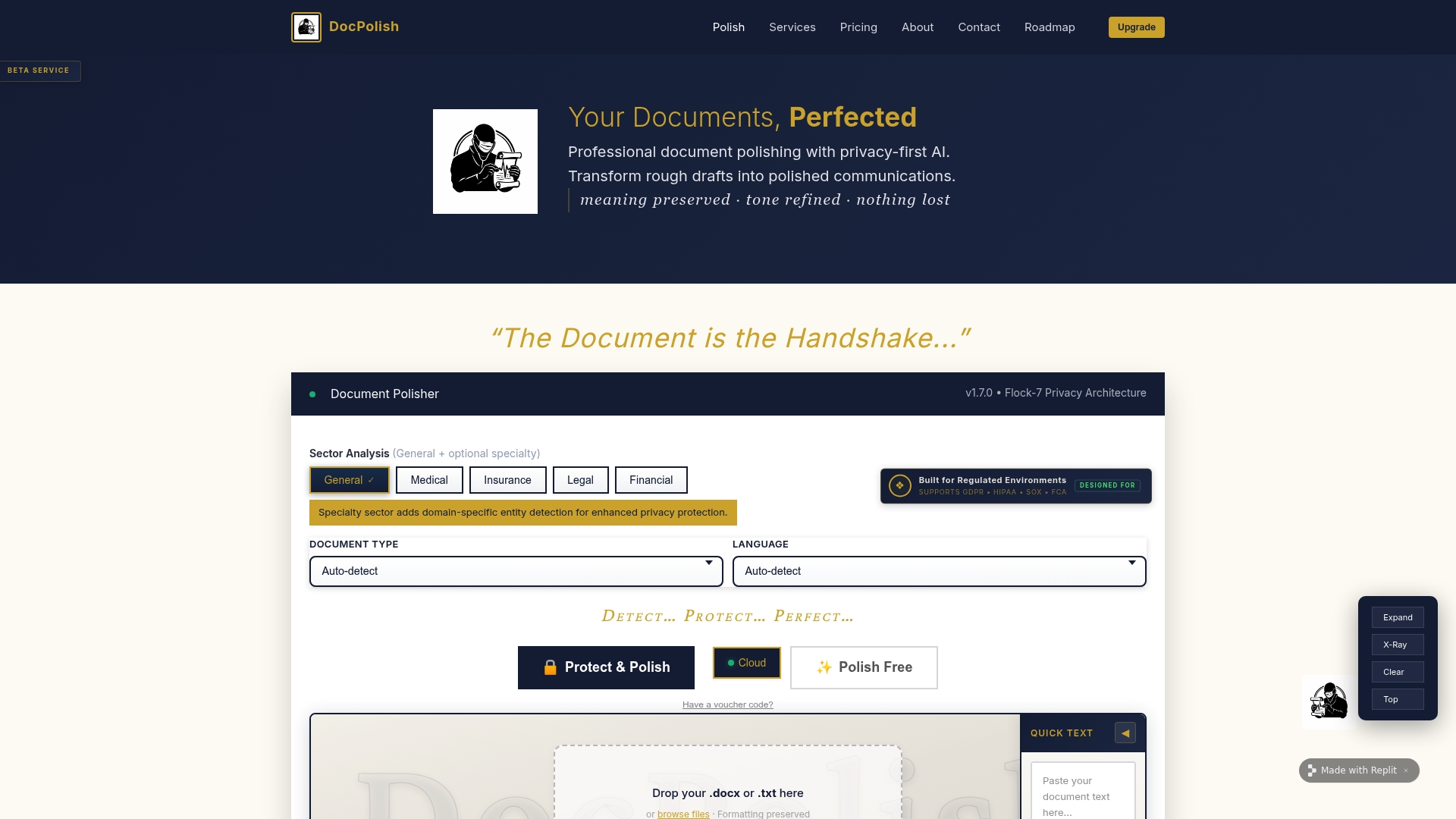
Docpolish processes documents entirely on the client side. Personally identifiable information is detected and anonymised within the user’s browser before any content reaches an AI engine for polishing. The original data is restored in the final output, and a trust identifier is generated for every document to support your audit trail. That architecture aligns directly with GDPR’s data minimisation principle and the privacy by design requirements that courts and regulators increasingly expect. For legal professionals who need AI-assisted document quality without compromising court record confidentiality, Docpolish offers a practical, compliance-ready starting point.
FAQ
What is the difference between anonymisation and pseudonymisation in court documents?
Anonymisation irreversibly removes all identifiers so that re-identification is not reasonably possible, placing the data outside GDPR’s scope. Pseudonymisation replaces identifiers with reversible labels and remains subject to full data protection obligations.
Which regulations govern how to anonymise legal documents in the UK?
CPR 39.2(4) governs court-ordered anonymisation in England and Wales, while GDPR and ICO guidance set the data protection standard for all personal data processing, including anonymisation decisions documented in DPIAs.
Why is 95% accuracy insufficient for court document anonymisation?
A single missed identifier in a legal document can expose a victim’s identity or breach a court order. Legal anonymisation requires recall levels approaching 99% for direct identifiers, achievable only through domain-specific AI training and human review.
Do protective orders replace the need to anonymise court records?
No. Protective orders restrict who can access a document during proceedings. Anonymisation controls what any reader can learn from a document after it is disclosed or published. Both measures address different risks and are often required together.
What should a DPIA record about anonymisation decisions?
A DPIA must document the protection tier selected, such as irreversible masking or pseudonymisation, the residual risks identified, and the data owner’s formal acceptance of those risks before any disclosure takes place.