Data safe document drafting for NHS staff: 2026 guide
Data safe document drafting for NHS staff is the practice of creating, handling, and sharing documents in ways that protect patient and staff information from the first keystroke to final transmission. The NHS operates under UK GDPR, the Data Protection Act 2018, and NHS information governance frameworks, all of which impose strict obligations on how personal data appears in documents. Getting this wrong carries real consequences: disciplinary action, regulatory fines, and harm to the people whose data you hold. This guide covers approved tools, best practices, retention rules, and the most common mistakes that put data at risk.
What tools are approved for data safe document drafting by NHS staff?
Approved tools for secure document creation in NHS settings must meet clinical safety standards, data protection requirements, and NHS infrastructure rules before staff should use them. Using an unapproved tool, even briefly, can expose patient or staff data to external servers outside NHS control.
In june 2026, NHS England granted 505,000 staff access to Microsoft 365 Copilot for document drafting assistance. That scale of deployment signals a clear direction: AI assistance is now part of approved NHS workflows, provided it operates within governed boundaries.

Any digital tool used for document signing or handling must meet the Digital Technology Assessment Criteria (DTAC) and the clinical safety standard DCB0129. Beyond that, digital signing solutions require a completed Data Protection Impact Assessment (DPIA) and must host data within UK infrastructure. A DPIA is a formal process that identifies and reduces privacy risks before a tool goes live. If a supplier cannot demonstrate UK data hosting and a completed DPIA, the tool is not compliant for NHS use.
Key requirements for any approved drafting or document tool:
- DTAC compliance: The tool must pass the NHS Digital Technology Assessment Criteria baseline.
- DCB0129 clinical safety: Applicable to tools used in clinical settings or affecting clinical workflows.
- DPIA completion: Required before deployment; must be reviewed when the tool changes significantly.
- UK data hosting: Data processed by the tool must remain within UK borders.
- Audit trail capability: The tool must log who accessed, edited, or transmitted a document.
Pro Tip: Before adopting any new drafting tool, ask your information governance lead whether a DPIA has been completed and whether the supplier holds a current DTAC certificate. If either is missing, do not use the tool for NHS documents.
What are the best practices for protecting patient and staff data when drafting?
The single most important rule in NHS document security is this: never input patient or staff identifiable data into an unapproved AI tool. AI tools in NHS settings are approved for drafting templates and improving document structure, not for storing or processing identifiable information. Treat every AI prompt as if it were public disclosure. If you would not post the content on a public noticeboard, do not type it into an unapproved system.
Data minimisation is the starting point for every document you draft. Include only the information that is strictly necessary for the document’s purpose. Role-based access controls should restrict who can view or edit a document to those with a direct need. This is not just good practice. It is a legal requirement under UK GDPR’s principle of data minimisation.
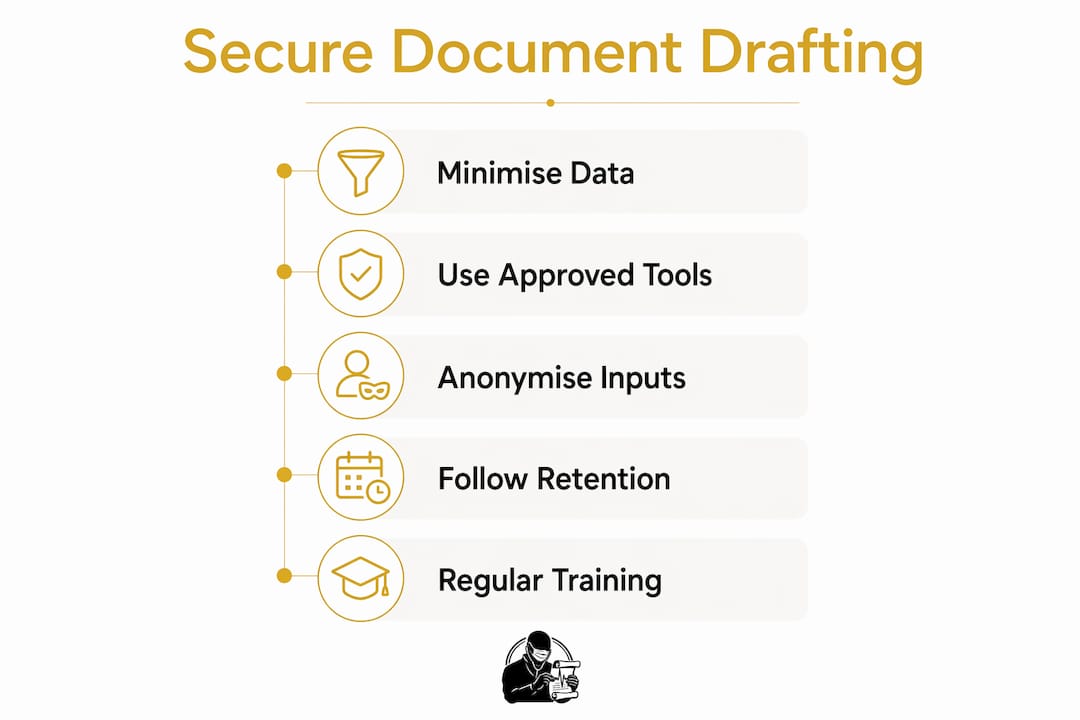
Non-patient data carries the same risks as patient identifiers. Workforce information, commercial data, and operational spreadsheets face identical exposure risks if uploaded to unapproved AI systems. Staff must segregate sensitive data carefully, regardless of whether it relates to patients or colleagues.
Follow these steps when drafting any document that contains personal or sensitive data:
- Identify the data type. Confirm whether the document contains patient identifiable information, staff data, or commercially sensitive content before you begin. Understanding what counts as patient PII is the foundation of every compliant drafting decision.
- Apply anonymisation or redaction. Where the final document does not require identifiable details, replace them with anonymised references before drafting begins.
- Use only approved platforms. Draft within NHS-approved systems such as Microsoft 365, and avoid copying content into external tools.
- Apply role-based access. Set permissions so only authorised colleagues can open or edit the document.
- Use secure transmission methods. For bulk transfers, NHS Wales defines a bulk transfer as sending personal information about more than 10 individuals simultaneously. Any such transfer requires a secure, controlled channel and documented authorisation.
- Validate after conversion. When converting documents between formats, post-conversion validation using checksums detects silent content corruption that can occur during digitisation.
Pro Tip: Apply the “public noticeboard test” to every AI prompt: if the text contains a name, NHS number, date of birth, or job title linked to an individual, remove it before you type.
How should NHS staff manage document retention and record-keeping?
Document retention is a legal obligation, not an administrative preference. The NHS Records Management Code of Practice 2021 sets the framework for how long different document types must be kept and how they must be stored. Failing to retain records for the correct period, or destroying them early, can expose your organisation to legal challenge.
Retention periods vary significantly by document type and patient age. Adult-related Patient Group Direction (PGD), Vaccine Group Direction (VGD), and Written Instruction (WI) documents must be retained for 8 years after expiry, or 10 years if the document relates to implants. Documents relating to children must be retained for 25 years. These are minimum periods. Local policy may require longer retention in specific circumstances.
| Document type | Patient group | Minimum retention period |
|---|---|---|
| PGD / VGD / WI | Adults | 8 years after expiry |
| PGD / VGD / WI (implants) | Adults | 10 years after expiry |
| PGD / VGD / WI | Children | 25 years |
| Patient Specific Directions (PSD) | Adults | 8 years |
| Patient Specific Directions (PSD) | Children | 25 years |
Authorised master copies of documents must be maintained separately from local clinical records. Version control is not optional. Every document should carry a clear version number, approval date, and the name of the authorising signatory. This creates the auditability that regulators and courts require.
Operational auditability means being able to reconstruct who accessed or sent a document, when, to where, and why. A vague “sent” log does not meet this standard. Your document management system must capture the full transmission record, not just confirmation that something was dispatched.
What common mistakes put data safety at risk during NHS document drafting?
The most damaging mistakes in NHS document workflows are rarely deliberate. They stem from time pressure, unfamiliarity with policy, or a misplaced belief that technical access equals lawful access.
The ICO is direct on this point: technical access to medical records is not justification for access. Curiosity-driven access to records is unlawful and can result in disciplinary action and criminal prosecution. Staff must verify a legitimate need before opening any clinical record, regardless of whether their system permissions technically allow it.
“Having access to a system does not mean you have the right to access the information within it. Accessing records without a legitimate reason is a serious breach of data protection law.” — Information Commissioner’s Office, 2026
Common mistakes that jeopardise NHS staff document security include:
- Inputting identifiable data into unapproved AI tools. Even a single name or NHS number entered into an external AI system can constitute a data breach under UK GDPR.
- Failing to validate documents after conversion. Silent corruption during digitisation can alter clinical content without any visible error message. Always run a post-conversion check.
- Inadequate audit trails. Sending documents without logging the recipient, date, and purpose leaves your organisation unable to demonstrate compliance if challenged.
- Ignoring bulk transfer rules. Sending data about more than 10 individuals without a secure, authorised channel breaches NHS Wales policy and equivalent guidance across NHS England and Scotland.
- Skipping the DPIA for new tools. Adopting a new drafting or signing tool without a completed DPIA is a governance failure, regardless of how widely the tool is used elsewhere.
Reducing these risks requires more than policy documents on an intranet. Staff need regular, practical training that connects the rules to their daily workflows. You can find detailed guidance on reducing data breach risk in document handling as a starting point for building that awareness.
Key takeaways
Data safe document drafting for NHS staff requires approved tools, anonymisation before AI use, strict retention compliance, and full operational audit trails at every stage.
| Point | Details |
|---|---|
| Use only approved tools | Any drafting or signing tool must meet DTAC, DCB0129, and DPIA requirements before NHS use. |
| Never input identifiable data into unapproved AI | Treat every AI prompt as public disclosure; use AI for structure and wording only. |
| Apply correct retention periods | PGD and related adult documents require 8 years minimum; children’s records require 25 years. |
| Maintain full audit trails | Logs must record who accessed or sent a document, when, to where, and why. |
| Validate documents after conversion | Post-conversion checksums detect silent corruption that standard reviews miss. |
Why culture matters as much as compliance in NHS document security
I have spent years watching NHS organisations invest heavily in approved platforms and governance frameworks, only to see data incidents caused by the same handful of human behaviours. Staff copy a patient list into a free AI tool because it is faster. A clinician opens a record out of curiosity about a colleague’s condition. A document is emailed without checking whether the recipient is authorised. None of these are technology failures. They are culture failures.
The uncomfortable truth is that policy documents do not change behaviour. Training that connects rules to real consequences does. When staff understand that curiosity-driven record access can end a career and result in prosecution, the behaviour changes. When they understand that a single misdirected email containing more than 10 individuals’ data constitutes a reportable breach, they start using secure channels.
AI integration makes this more urgent, not less. Microsoft 365 Copilot is now in the hands of hundreds of thousands of NHS staff. That is a genuinely useful development for document drafting efficiency. But the same tool, used carelessly, can expose workforce data, commercial information, and operational details that staff do not even recognise as sensitive. Non-patient data carries the same legal weight as patient identifiers under UK GDPR.
My advice is to build one simple habit across your team: before drafting any document that touches personal data, ask whether the tool is approved, whether the data is necessary, and whether the transmission is secure. Three questions. Every time. That discipline, applied consistently, closes more gaps than any software update.
How Docpolish supports secure document drafting for NHS teams
NHS staff need a drafting tool that improves document quality without ever exposing personal data to external servers. Docpolish is built precisely for that requirement.
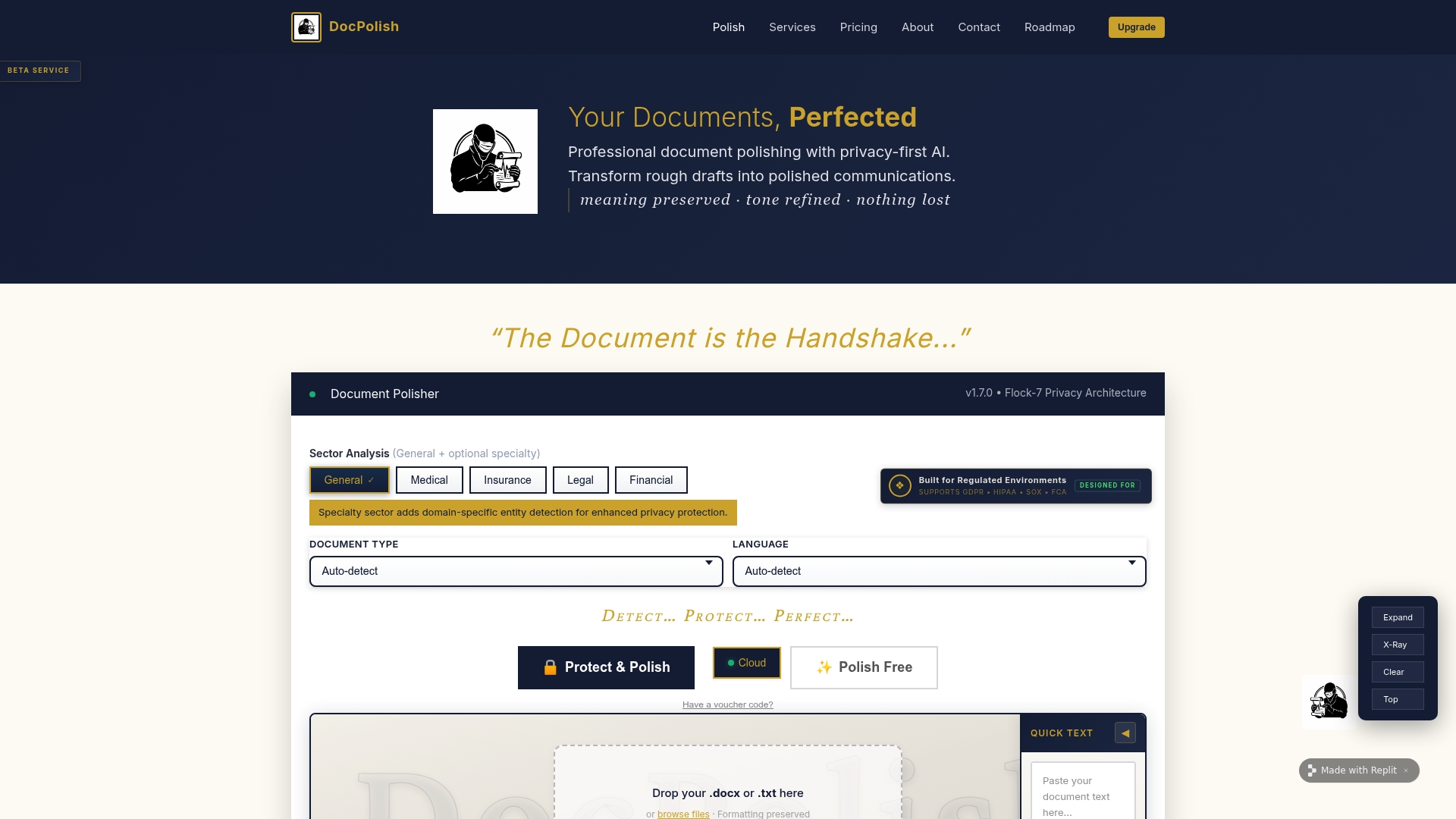
Docpolish detects and anonymises personally identifiable information directly within your browser before any content reaches an AI engine. The original data is restored in the final output, so the document reads naturally while the underlying PII never leaves your device. Every processed document receives a trust identifier, creating the audit trail that NHS information governance requires. For teams working under UK GDPR and NHS data protection standards, that architecture is not a feature. It is the foundation. Visit Docpolish for healthcare teams to see how it fits your existing NHS workflows.
FAQ
What does data safe document drafting mean for NHS staff?
Data safe document drafting is the practice of creating NHS documents in ways that protect patient and staff personal data throughout the drafting, editing, and transmission process, in compliance with UK GDPR and NHS information governance standards.
Can NHS staff use AI tools for document drafting?
Yes, but only approved tools. As of june 2026, NHS England has deployed Microsoft 365 Copilot to 505,000 staff for this purpose. Staff must not input patient or staff identifiable data into any unapproved AI system.
How long must NHS document records be retained?
Adult PGD, VGD, and WI documents must be retained for at least 8 years after expiry, or 10 years for implant-related documents. Records relating to children must be retained for 25 years.
What is a DPIA and why does it matter for NHS document tools?
A Data Protection Impact Assessment (DPIA) is a formal process that identifies privacy risks before a digital tool is deployed. Any digital signing or document handling tool used in the NHS must have a completed DPIA and must host data within UK infrastructure.
What happens if NHS staff access records without a legitimate reason?
The ICO states that technical access to a system does not justify accessing the information within it. Curiosity-driven access to medical records is unlawful and can result in disciplinary action and criminal prosecution under data protection law.