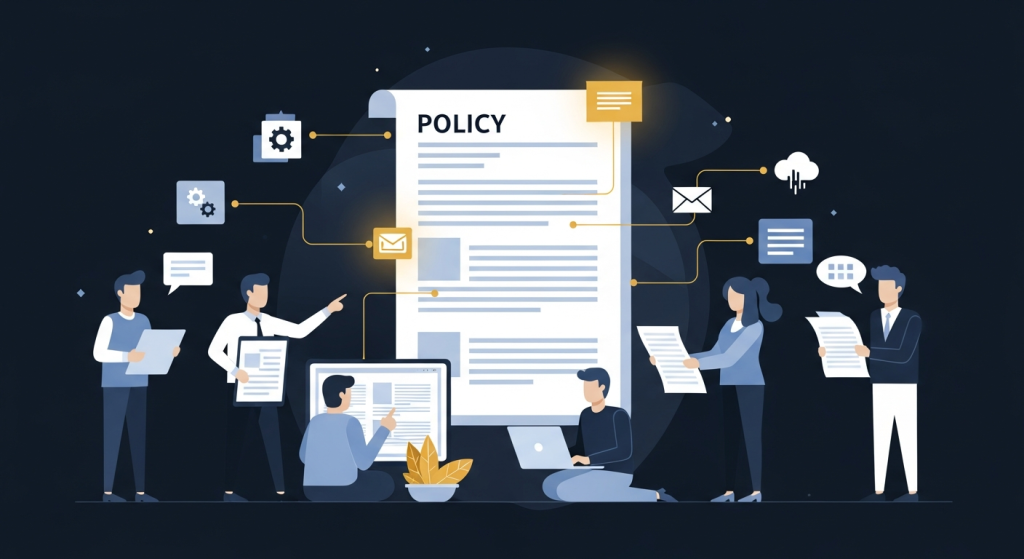
Financial services firms produce an extraordinary volume of documents: client reports, regulatory filings, risk disclosures, marketing materials, and internal policy memos. Each of these documents must be accurate, clear, and compliant. They also frequently contain sensitive personal and commercial information that makes them high-value targets for data breaches and regulatory scrutiny.
The Problem with Traditional Approaches
Most document improvement tools require uploading files to a cloud service. For a financial institution, this means adding another data processor to the compliance register, updating the DPIA, reviewing the DPA, and conducting vendor due diligence. The process is slow, expensive, and never truly eliminates the risk that the vendor’s server could be compromised.
Even where the risk is accepted, the practical workflow is clunky. A compliance officer downloads a document, anonymises it manually, uploads it to the tool, downloads the improved version, and restores the original identifiers. This manual pseudonymisation is error-prone, time-consuming, and scales poorly.
How DocPolish Fits the Workflow
DocPolish automates the entire process inside the browser. A relationship manager uploads a client report, and the system immediately detects and replaces sensitive entities with placeholders. The anonymised text is sent to the AI engine for language polishing—improving clarity, fixing grammar, and standardising tone. The polished text returns, and the placeholders are restored in their original positions.
The result is a document that reads more professionally, communicates more clearly, and has never exposed its raw contents to an external server. The compliance officer’s job becomes simpler, not harder. The relationship manager gets better documents faster. The firm’s risk register stays shorter.
Structural Preservation
Financial documents often have complex formatting: tables, footnotes, headers, and numbered sections. DocPolish preserves the document structure during polishing. A risk table with three columns and twelve rows emerges with the same layout, but with clearer language in each cell. This is critical for documents where formatting carries meaning, such as regulatory filings and audit reports.
For financial services firms operating under the FCA, SEC, or ECB, this combination of privacy, accuracy, and structural fidelity is not a nice-to-have. It is a prerequisite for adopting any AI-assisted document tool.