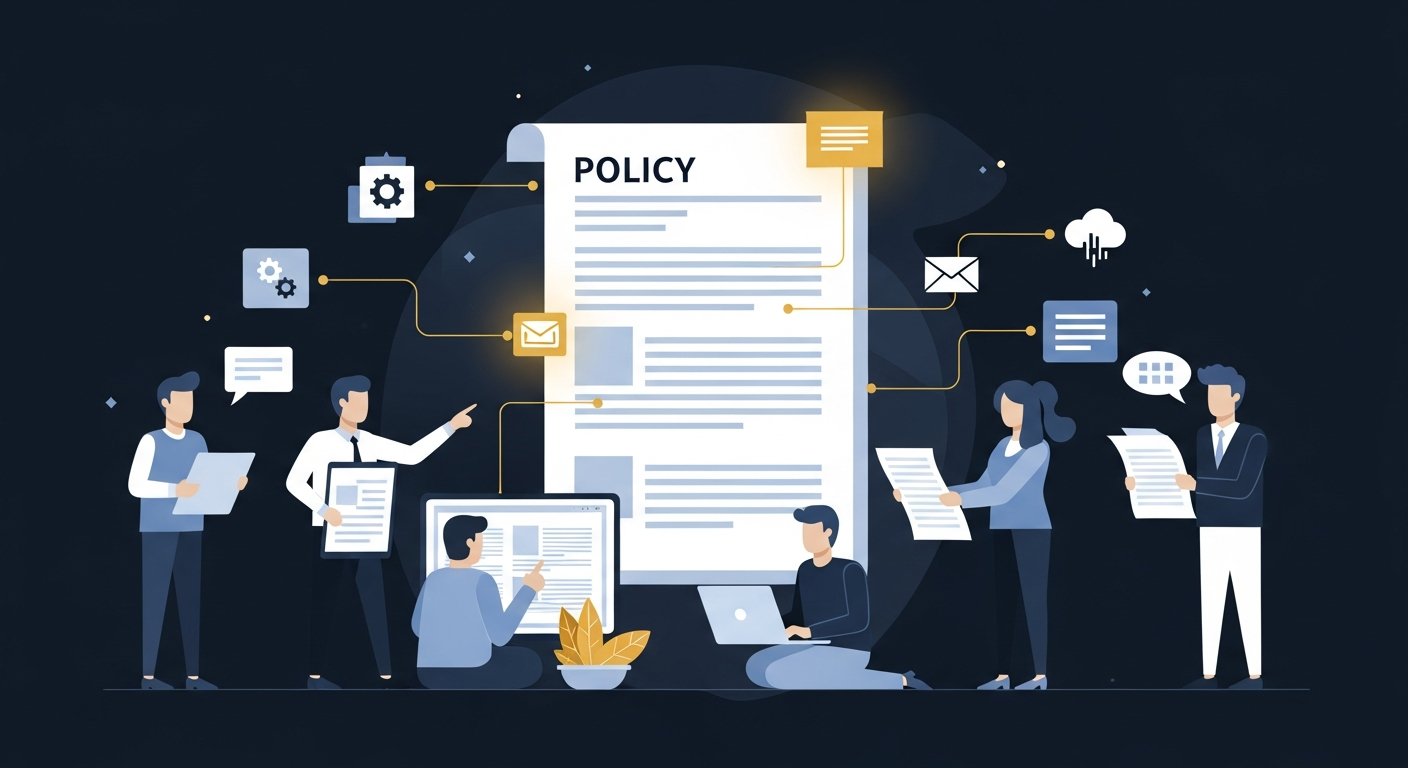
Policy documents are among the most carefully written texts in any organisation. They must be legally precise, internally consistent, accessible to the intended audience, and maintainable over time. A single ambiguous clause can create liability. A single outdated reference can undermine compliance. The stakes are high, and the workflow is traditionally slow.
The Traditional Bottleneck
A typical policy document moves through multiple hands: the subject matter expert drafts the content, the legal team reviews for compliance, the communications team edits for clarity, the compliance team checks against regulatory requirements, and the leadership team approves for publication. Each handoff introduces delay, and each round of revision risks introducing new errors.
The bottleneck is not the expertise itself; it is the coordination. Experts spend more time managing document versions and chasing feedback than they do improving the content. The process scales poorly, and the quality of the final document often reflects the time available rather than the expertise available.
Bringing AI into the Loop
AI-assisted document polishing can remove the purely mechanical delays from this workflow. Grammar, style, and readability improvements that would take a communications editor hours can be applied in seconds. The expert can review the AI’s suggestions, accept or reject them, and move to the next section. The legal team can focus on substantive compliance questions rather than fixing sentence fragments.
The concern, of course, is control. No policy officer wants an AI to rewrite a liability clause without oversight. The correct implementation is not to replace the expert review but to accelerate it. The AI proposes; the human decides. The tool is an assistant, not an author.
Maintaining Control with Client-Side Processing
The control concern extends to data handling. Policy documents often contain sensitive strategic information, employee data, or customer references that should not be exposed to third-party servers. DocPolish addresses this by processing the document entirely in the browser. The AI sees only anonymised placeholders. The organisation retains full control over what leaves its network perimeter.
This makes the workflow practical for organisations with strict data governance requirements. A government department can improve policy papers without sending them to cloud providers. A multinational can standardise regional policies without exposing competitive strategy. A healthcare provider can update clinical protocols without risking patient data exposure.
A Practical Implementation
The recommended workflow is straightforward: draft the policy in the usual tool, upload to DocPolish for language polishing, review the AI suggestions against the original intent, and export the improved document back to the document management system. The entire cycle takes minutes rather than days, and the quality improvement is consistent across all sections of the document.
For organisations that produce large volumes of policy or regulatory content, this workflow transformation is not a minor efficiency gain. It is a fundamental change in how expertise is deployed, how quality is maintained, and how compliance is demonstrated.