Secure document processing for finance teams: 2026 guide
Secure document processing for finance teams is the practice of protecting sensitive financial records through encryption, access controls, digital signatures, and lifecycle policies that together guarantee confidentiality, integrity, and regulatory compliance. The discipline draws on standards such as AES-256 encryption, TLS 1.2+ in transit, and multifactor authentication, alongside compliance frameworks including SOC 2 Type 2, GDPR, and HIPAA. Platforms such as DocSumo and IdenTrust have demonstrated that intelligent document processing can achieve 99%+ accuracy while meeting these frameworks. That level of accuracy matters because a single misclassified document in a regulated environment can trigger an audit or a breach notification. Finance teams that treat document handling as a core operational discipline, rather than an IT afterthought, consistently outperform peers on both compliance scores and incident rates.
1. What are the essential features of secure document processing solutions?
Finance teams need layered protection, not a single control. Encryption at rest and in transit using AES-256 and TLS 1.2+ is the baseline. Physical copies of sensitive documents belong in UL-rated safes capable of withstanding 1,700°F for 30 minutes. Digital equivalents require the same rigour applied to storage architecture.
Role-based and attribute-based access controls determine who can view, edit, or approve each document. Step-up authentication, where a user must re-verify identity before accessing the most sensitive files, adds a second gate beyond the initial login. These controls work together to limit the blast radius of any compromised account.

Audit trails are non-negotiable. Every access event, edit, and approval must be captured with a timestamp and user identifier. True security requires audit trails, key rotation, granular logs, and proof of deletion at end-of-life. Encryption alone does not satisfy a regulator asking who touched a document and when.
Document classification underpins everything else. Fewer than ten classification labels produce more consistent policy application by staff. Too many labels create confusion, and confused employees make poor security decisions.
Pro Tip: Rotate encryption keys on a defined schedule, quarterly at minimum, and maintain granular access logs that record not just who accessed a file but from which device and IP address. Regulators increasingly ask for this level of detail during SOC 2 audits.
2. Which technologies lead financial document security in 2026?
AI-powered intelligent document processing platforms extract, classify, and route financial documents with minimal manual intervention. DocSumo specialises in financial services and combines optical character recognition with compliance controls. Ondox targets regulated industries with a focus on document verification workflows. Both reduce the human error that creates security gaps in high-volume finance operations.
Digital signature providers such as IdenTrust use public key infrastructure (PKI) to deliver authentication, integrity, and non-repudiation for finance contracts. Non-repudiation means a signatory cannot later deny having signed a document. That property is legally critical for loan agreements, audit sign-offs, and board resolutions.
| Technology | Primary use | Key compliance feature |
|---|---|---|
| DocSumo IDP | Document extraction and classification | SOC 2 Type 2, GDPR, HIPAA |
| IdenTrust PKI signatures | Contract signing and identity proofing | Non-repudiation, legal enforceability |
| AES-256 encryption | Storage and transit protection | GDPR Article 32, HIPAA Security Rule |
| Controlled sharing platforms | Secure file distribution | Link expiry, download restrictions, revocation |
Secure file sharing solutions add another layer by controlling what recipients can do with a document after it is delivered. Download restrictions, watermarking, and link revocation prevent a document from spreading beyond its intended audience. Finance teams that rely on email attachments instead lack all three of these controls.
Pro Tip: Choose platforms that combine identity proofing with audit logging in a single pipeline. Buying these capabilities separately creates integration gaps that attackers exploit and auditors flag.
3. How do secure sharing and document lifecycle controls protect finance data?
Controlled sharing is the point where most finance teams leak data without realising it. Sending sensitive files as email attachments removes all control the moment the recipient downloads the file. Controlled platforms retain revocation rights and provide engagement analytics showing exactly when and how a document was accessed.
Link expiry is the simplest and most underused control. Highly sensitive documents should use a 3–7 day expiry window. Proposals and lower-sensitivity materials can extend to a 14-day window. After expiry, the link becomes inactive regardless of whether the recipient saved it.
The document lifecycle extends well beyond the sharing event. Finance teams must address ingestion, processing, storage, archival, and deletion as a continuous chain. Mapping the entire lifecycle, including caches and indexing services, prevents shadow copies from sitting unencrypted in temporary storage. A document that is encrypted in the main repository but cached in plaintext in a search index is not secure.
Key sharing controls every finance team must enforce:
- Disable download and print for documents classified as highly sensitive
- Set link expiry to 3–7 days for sensitive files and 14 days for standard proposals
- Use platforms that log every access event with timestamp and recipient identity
- Apply encryption to all storage locations, including caches and backup archives
- Require multifactor authentication before granting access to shared documents
- Maintain revocation capability so access can be withdrawn after sharing
4. What common pitfalls should finance teams avoid?
The most common mistake is treating encryption as a complete security solution. Encryption alone does not produce the tamper-evident trails regulators require. A file can be AES-256 encrypted and still be accessed by the wrong person if access controls are poorly configured.
Confusing electronic signatures with cryptographically secured digital signatures is a costly error. An electronic signature is often just a typed name or a scanned image. A PKI-based digital signature cryptographically binds the signatory’s identity to the document at the moment of signing. For high-value finance contracts, only the latter provides legal enforceability and non-repudiation.
Shadow copies are an overlooked gap. Document workflows generate temporary files in caches, indexing services, and preview renderers. These shadow copies are security gaps unless explicitly encrypted and access-controlled. Finance teams that audit their primary repository but ignore ancillary storage leave sensitive data exposed.
Vendor risk management is frequently underdeveloped. Every third-party tool in a document workflow is a potential breach vector. Finance teams must assess each vendor’s security certifications, data residency commitments, and incident response procedures before onboarding.
Pro Tip: Apply minimal access permissions using attribute-based rules. A staff member in accounts payable should not have access to board-level financial reports simply because both document types live in the same system.
5. How can finance teams design audit-ready document processing workflows?
An audit-ready workflow captures evidence at every stage: submission, processing, approval, and archival. The goal is to answer any regulator’s question about a document’s history without manual reconstruction. Layered protection combining identity verification, encryption, consent management, and audit logging is the architecture that achieves this.
Immutable audit trails are the centrepiece. Tamper detection mechanisms, such as cryptographic hashing of log entries, ensure that audit records cannot be altered after the fact. This is the difference between a log that records events and a log that proves events occurred as recorded.
Digital signatures from PKI-certified providers such as IdenTrust tie legal enforceability to the workflow. Every approval in the chain carries a cryptographic proof of who signed, what they signed, and when. That proof survives legal scrutiny in a way that a simple checkbox approval does not. For finance teams operating under GDPR or SOC 2, this level of traceability is not optional.
| Compliance requirement | Control to implement | Verification method |
|---|---|---|
| SOC 2 Type 2 | Immutable audit logs with tamper detection | Third-party audit review |
| GDPR Article 32 | AES-256 encryption at rest, TLS 1.2+ in transit | Data protection impact assessment |
| HIPAA Security Rule | Multifactor authentication, access controls | Internal risk assessment |
| Financial regulations | PKI digital signatures, non-repudiation | Legal review of signed documents |
| Vendor risk | Third-party security assessments | Vendor questionnaire and certification review |
Approval routing must be built into the workflow, not bolted on afterwards. When a document moves from drafter to reviewer to approver, each transition should generate a timestamped record. Finance teams can use platforms that integrate KYC document handling and compliance controls into a single pipeline, reducing the number of handoffs where data can be exposed.
Key takeaways
Secure document processing in finance requires layered controls, including encryption, access management, PKI digital signatures, and immutable audit trails, to satisfy regulators and prevent data breaches.
| Point | Details |
|---|---|
| Encryption is the baseline, not the solution | Pair AES-256 encryption with audit trails, key rotation, and access controls to meet SOC 2 and GDPR requirements. |
| PKI signatures outperform basic e-signatures | Use PKI-based digital signatures for finance contracts to achieve legal non-repudiation and enforceability. |
| Link expiry limits sharing exposure | Set 3–7 day expiry windows for sensitive documents and disable download and print to prevent leakage. |
| Shadow copies are a hidden risk | Map the full document lifecycle, including caches and indexing services, and encrypt every storage location. |
| Classification must stay simple | Use fewer than ten document labels so staff apply security policies consistently and correctly. |
Why layered security beats any single tool
Finance teams often arrive at document security through compliance pressure rather than genuine risk understanding. I have seen organisations invest heavily in a single encryption platform, tick the GDPR box, and then suffer a breach through an uncontrolled email attachment workflow that nobody thought to audit. The technology was sound. The process was not.
The teams that handle this well share one characteristic: they treat document handling as a product feature, not a compliance checkbox. Every document that passes through their systems carries a traceable identity, from ingestion to deletion. When an auditor asks who approved a payment instruction, the answer comes from a system record, not from someone’s memory or inbox.
The regulatory direction in 2026 is unambiguous. SOC 2 Type 2 auditors, GDPR supervisory authorities, and financial regulators are all moving towards demanding cryptographic proof of document integrity, not just policy statements. Organisations that have invested in PKI-based signatures and immutable audit logs are already positioned for this. Those relying on basic electronic signatures and manual logs face expensive remediation.
My strongest recommendation is to prioritise identity proofing and auditability over feature count when evaluating platforms. A tool that does fewer things but produces a legally defensible audit trail is worth more to a finance team than a feature-rich platform with weak logging. Invest in the controls that survive scrutiny, because eventually, every finance team faces scrutiny.
How Docpolish supports secure document processing for finance teams
Finance teams need a document processing solution that protects sensitive data without disrupting existing workflows. Docpolish is built for exactly this environment.
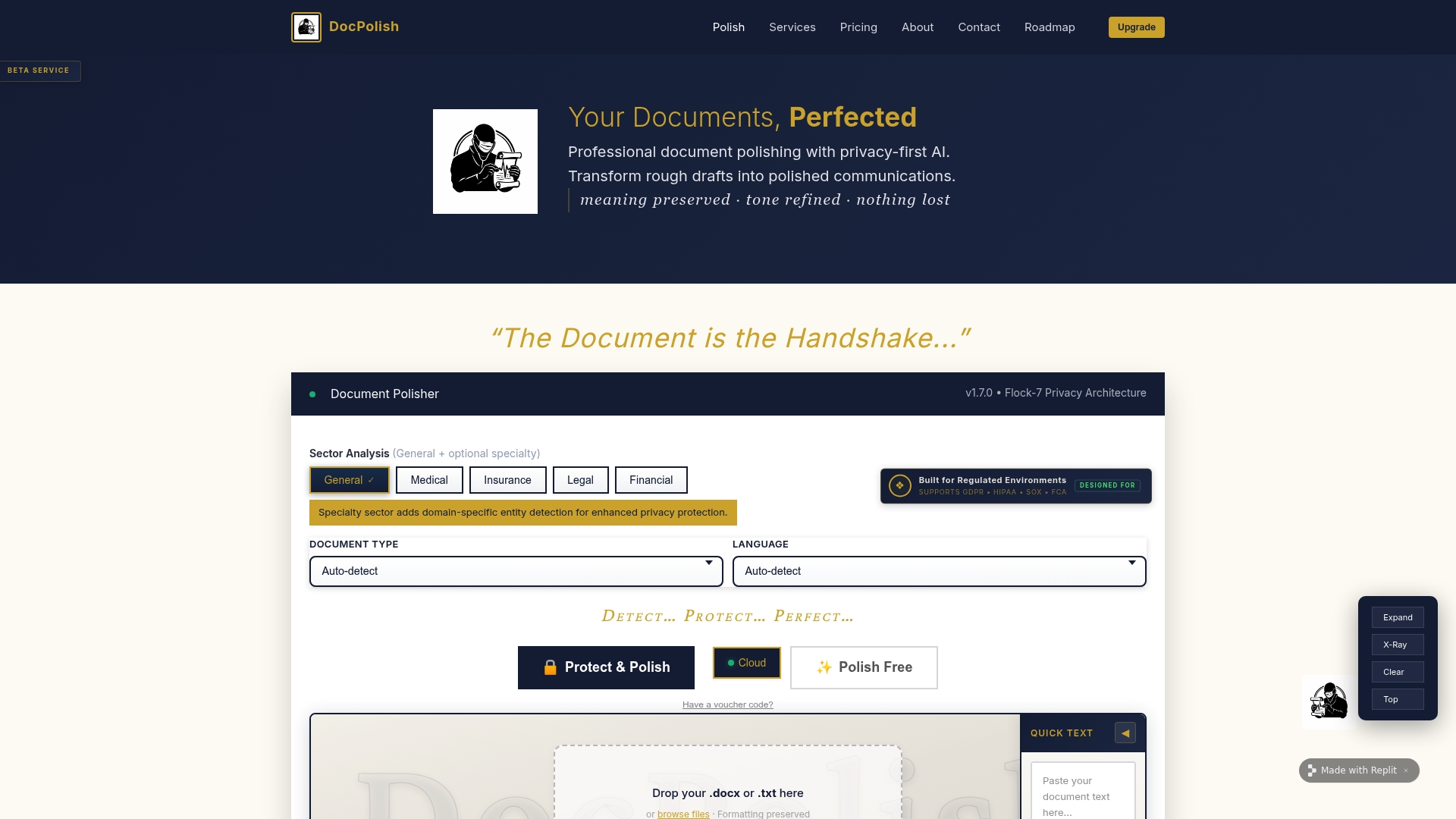
Docpolish detects and anonymises personally identifiable information directly in the user’s browser before any document reaches an AI processing engine. The original data is restored in the final output, meaning sensitive financial information never leaves the client side unprotected. Every processed document receives a trust identifier, creating an audit trail that satisfies GDPR and HIPAA requirements. For finance professionals managing contracts, reports, and client records, that combination of privacy and traceability is the standard that regulators now expect. Explore the Docpolish platform to see how it fits your compliance requirements.
FAQ
What encryption standard should finance teams use for document storage?
Finance teams should use AES-256 encryption for documents at rest and TLS 1.2+ for documents in transit. These standards satisfy GDPR Article 32 and the HIPAA Security Rule.
What is the difference between an electronic signature and a digital signature?
An electronic signature is typically a typed name or image with no cryptographic binding. A digital signature uses PKI technology to cryptographically link the signatory’s identity to the document, providing legal non-repudiation.
How long should secure document sharing links remain active?
Highly sensitive financial documents should use a 3–7 day link expiry window. Standard proposals and lower-sensitivity materials can use up to a 14-day window before the link is deactivated.
Why are shadow copies a security risk in document workflows?
Shadow copies are temporary files created in caches and indexing services during document processing. If these copies are not encrypted and access-controlled, they expose sensitive data outside the main secure repository.
Which compliance frameworks apply to financial document processing?
SOC 2 Type 2, GDPR, and HIPAA are the primary frameworks for financial document security. Each requires a combination of encryption, access controls, audit logging, and documented data retention and deletion policies.